
|     |
|
| |

 e-mail: khokar1960@gmail.com Rama: The gold standardPhotos: Santosh JanardhananFebruary 9, 2026 Rama is her name and dance is no game to her - but her calling. A Kerala girl, who had the distinction of becoming the first student of Andhra queen of Kuchipudi, Odissi and Bharatanatyam - guess who? The one and only prima donna of Indian dance Yamini Krishnamurthy- has grown today to become a benchmark of Bharatanatyam not only in her base Delhi but all over India in her age group (50-60). More than a benchmark, actually, the gold standard... Her soothing offering to rasikas and common person was seen and savoured in Bangalore at HCL Concerts, Chowdaiah Hall, on Republic Day. That's one day when Bangalore roads were usable because there was less traffic! With just four students and four musicians she created a magnum opus of beauty, sensitivity and substance - Maalyada - An ode to Andal. Her palette is muted and plate is uncluttered; oeuvre is vast and art that lasts. Rama has reached the height from where she can purvey much and others can look up to her with affection and adoration. What's the tool? First and foremost a solid foundation. Yamini Krishnamurthy has not produced hundreds like a factory but one diamond - Rama. Today, if she shines it is because she has come through fire. Mother-in-law guru Saroja Vaidyanathan tested her over 30 years of running an institute she created in outskirts of Delhi near Qutb Minar. Rama was the dutiful bahu, then mother of two darling daughters - one a fine dance talent Dakshina and other an able mridangist Sannidhi. Rama has done hard, hard work of over 40+ years under two demanding gurus - first, the diva and temperamental Yamini Krishnamurthy and second a saas-guru, Delhi's senior South Indian Bharatanatyam proponent Saroja Vaidyanathan. Her husband being an IAS of Bihar cadre, served in Delhi too on deputation as one time union Health Secretary in the mid 1980s and those days Delhi was in expansion mode, so land was being given in batches to dancers and musicians to create new institutions. Ganesa Natyalaya came up in Qutb Institutional Area. Wilderness then, it is now settled down and a happening area with many institutions there. Every 20 years Delhi moves further and further south. First cultural institutional areas in the 1960s were the ITO - Rouse Avenue (now Deen Dayal Upadhyay Marg) which has Gandhi Peace Foundation and the Gandharva Mahavidyalaya. Then Mandi House area. Triveni, SNA, LKA, NSD, SBKK. Then arose the Lodhi institutional area in the 1960s. The India International Centre. Telugu Sangam and Sai Baba temple. HABITAT in the 1990s. Then Andrews Ganj area where many schools and colleges were given land. Then Qutb Institutional in the 1980s, then Vasant Kunj in the 1990s. And Tughlakabad of late in this century. Today Delhi has reached beyond Sohna in Haryana, Greater Noida in U.P and Neemrana in Rajasthan. Rama runs the Ganesa Natyalaya now and shuns faltu show. In a city, where showing off is the sthayi bhava and shaitan singhs abound in every nook and corner (to act like crabs to pull down anyone going up the cauldron), Rama has kept to the grind, keeping a low profile and slowly building a body of work that has stood the test of time. And students. Yes, for any institution to succeed, students are the backbone. In that, Rama today runs the best Bharatanatyam dance teaching institution. Others do too, but they are drawing room or garage or rooftop home schools! Just extension of egos, if not social climbing. Rama's school - that's what Ganesa Natyalaya is now - aided by her ebullient and efficient husband Kamesh, do Delhi proud. He worked for Hitachi, so has Japanese discipline and team work spirit, remains low profile but ever smiling face of the institution. Ganesa Natyalaya and Rama Vaidyanathan now have students and followers not only in Delhi but far away in Mangalore and Kolkata... USA and Greenland! Founded in 1976 as one of India's original IT start-ups, HCL is a pioneer of modern computing with many firsts to its credit, including the introduction of the 8-bit microprocessor-based computer in 1978 well before its global peers. Today, the HCL enterprise has a presence across varied sectors that include technology, healthcare and talent management solutions and comprises three companies - HCL Infosystems, HCL Technologies and HCL Healthcare. The enterprise generates annual revenues of US $14.5 Billion with 226,300+ employees operating across 60 countries. Started in 1998 by HCL Group, HCL Concerts is one of the largest and longest running performing arts platforms in India. It organizes music and dance concerts in 12 cities regularly throughout the year. In 28 years, close to 850 concerts have been organized, showcasing over 3,500 e to over 325,000 attendees. Over the years, more platforms have been developed to contribute to the growth of the Indian music and dance ecosystem. Most notable of these are digital concerts by young artistes. Over 140 million people from 62 countries have attended the 220+ digital concerts till date. HCL Concerts also runs Carnatic Quest, India's largest talent identification platform for aspiring Carnatic musicians. 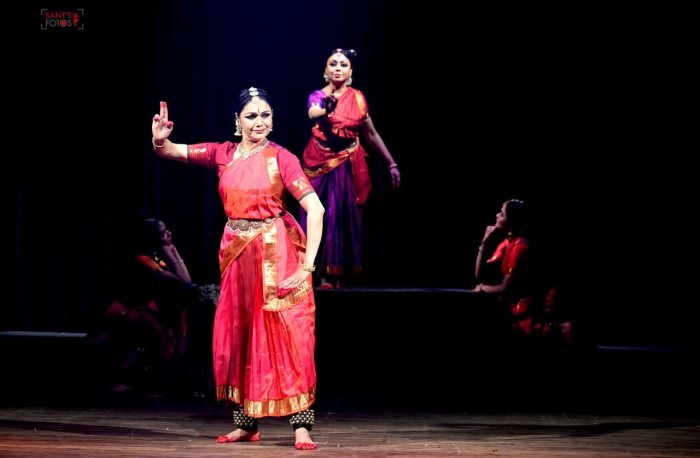 Maalyada - Andal’s sacred garland is a dance adaptation by the star of Bharatanatyam Rama Vaidyanathan, based on the book by Jeysundhar D with music composition by Sudha Raghuraman. It sounds very simple, this sentence "music composed by..." but seeing and hearing is believing. What a voice. OMG! Maalyada brings out the hidden meaning of the 9th century text, Thiruppavai, through casual conversations between Andal and her friends that are replete with philosophical content. The author also gives us a more holistic understanding of Andal’s poetry by quoting ancient scriptures that find relevance in this young girl’s words of wisdom. As the voice of the book, the choreographer Rama Vaidyanathan, takes us through the journey that Andal and her friends embark upon, to seek Krishna. Andal’s scared garland therefore becomes a metaphor for the nine forms of Bhakti where each form is like a flower that is represented by a pasuram that finally strings the whole garland together as an offering to Lord Krishna. The path that Andal chooses is that of the Nava Vidha Bhakti - nine forms of devotion that a devotee experiences before realising the divine, namely: 1 - Shravanam: Let us hear the name of the Lord! 2 - Smaranam: Let us contemplate upon Him! 3 - Sankeerthanam: Let us sing His praises! 4 - Vandanam: Come join me in praying to Him! 5 - Archanam: Everything we do is an offering unto Him! 6 - Pada Sevanam: We surrender at your lotus feet! 7 - Sakhyam: The one who Krishna befriends always wins! 8 - Dasyam: Praise be to your prowess! 9 - Atma Nivedanam: We dedicate this birth and all other births to your everlasting service! (So many exclamation marks made me exclaim when I read the above program notes! We Indians love excess or are rather democratic!) 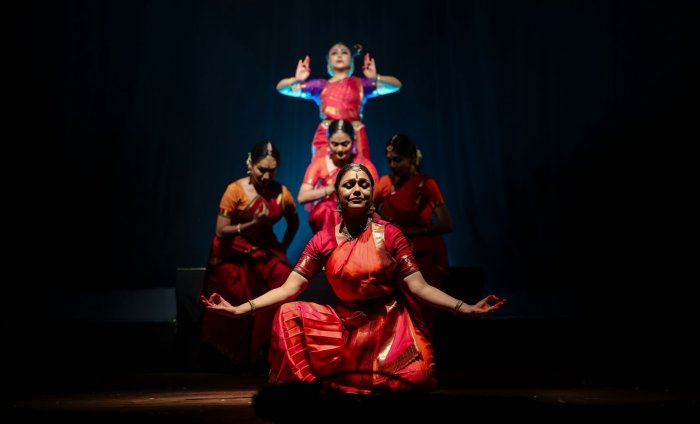 If the dance ensemble work was exceptional then the musical glow and backbone was first rate. Thanks to its creator and curator Sudha Raghuraman. She is a performer par excellence. How can anyone sing with so much emotion, depth and substance live for 90 minutes? Without a break or even once, faltering. And such a variety of ragas, pitches and music scapes. Only a solid singer, a genius. The show actually hangs on her singing. She also sometimes becomes a side show: One doesn’t know if one should look at her or the dancers! Himanshu Srivastava injected with energy the mnemonic syllables where needed and G.Raghuraman played the flute as a perfect support. Sannidhi Vaidyanathan played as many as five instruments from Manjira to Khanjeera to Mridangam to Kirtalam. The main mridangist Sumodh Sreedharan was first class, minimalistic yet apt and effective. Lights by Bangalore's own talent Surya Rao were of precision and effectiveness, creating the right mood. Reshika Sivakumar, Sayani Chakraborty, Shubhamani Chandrashekar and Vaishnavi Dhore were part of the ensemble work steered by Rama herself. First rate team work. One pose (in pic) of reclining Vishnu with Laxmi at feet, was so real life, I thought I was in Padmanabhaswamy temple in my college senior Shashi Tharoor's constituency - Trivandrum! The split stage used for musicians also duplicated as props and passages for dancers to weave through. This is one production that should be seen all over India and abroad where they understand the best Indian classical dance have to offer. Diaspora Indians must sponsor this work and get it to wherever they are. The production values make one proud. 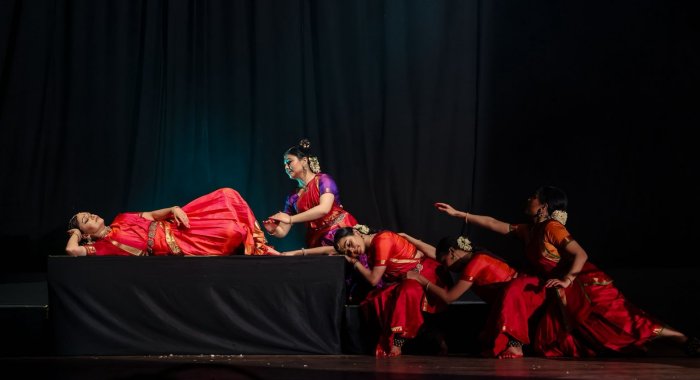 Why? First of all there's discipline. Most of us very democratic Indians can't function in teams. But Rama Vaidyanathan has instilled that. Forever in short supply in that rowdy Rathore land of Delhi NCR (and I've lived there 40 years so I've nothing against it as I've seen the city grow from a village to a bigger village!). Then there's Rama's superb aesthetics, minimal but fulsome. Costumes, make up, even the garland, especially Andal’s was so fresh! The mirror frame was such a simple devise that Andal saw only Krishna in reflection, peacock plume and all. Then her institution looks, works and delivers like a well oiled Rolls Royce. Or a German electric car. No sound, only substance. Add a professional team and support systems. There are no others in Delhi to match in scale or substance. The reason is: content is the king. Merely teaching a form isn't enough. Rama Vaidyanathan's school teaches everything: etiquette, aharya, history and heritage; music and sahitya. A student coming out of it is well rounded. Imagine a Bengali doing Andal. That's why she can. Sans ego. That's what's happened in her Maalyada. Rama did not undertake the main role. Dancers- especially gurus and seniors past their expiry date - suffer from an exaggerated sense of self importance that without looking at the mirror which cannot contain their size XXL frame anyway, even from a side angle, still have the gumption to function as the chief role or protagonist. So a 70 going on 80 and beyond undertakes roles meant for 20/30 year olds as per the theme, the story! While a dancer mostly enacts a role, often merging with the character, it is an insult to audience sensibilities today for an over-the-hill, democratically healthy dancer to try to pass off as a teenager! Rama can, at 50+ but didn't do Andal. She let a well groomed youngster Sayani Chakraborty do that. A guru gives. That's a real guru. For all the talk of high art, there are low level teachers who are just basking in past norms of GSP (guru shishya parampara) when not mouthing other inanities. No wonder art is so mediocre today and audiences meagre. That's why, when product is so sub standard, then tickets rarely sell for classical dance. TV shows bypass these or show as novelty and dancers themselves are to be blamed collectively for having turned rasikas away. Who will pay for their paltry wares and share the sub standard content as high art? The socialist model of the sixties and seventies of state-run patronage is truly over. As is the come one, come all to my show, family and friends model. In 2026, internet rules. That's why TV shows are succeeding. It's a common, level playing field now. Anyone can dance! India's got lotsa talent! Only one or two can be truly called in each form, the benchmark or the gold standard. Rama Vaidyanathan is one. 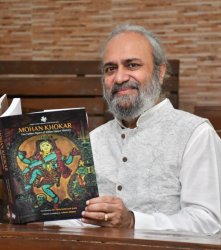 Critic, connoisseur, historian, author, artivist, archivist, administrator and more - editor, columnist and mentor Ashish Khokar remains true to his muse. More on attendance-india.com Response * Very well written, sir, I totally agree. - Anagha Neralkar (Feb 10, 2026) Post your comments Please provide your name along with your post. All appropriate comments posted with name in the blog will also be featured in the site. |
