
|     |
|
| |

BOOK REVIEWFrom the Corner of Her Eye: The Many Histories of Bharatanatyam- Dr. Ragothaman Yennamallie-mail: ragothaman@gmail.com November 5, 2026 A week ago, I came to know that the Delhi-based dancer Justin McCarthy had penned a book on dance history titled From the Corner of Her Eye, published by Juggernaut. He is someone I have always considered a thinking dancer, one who puts a great deal of thought and energy into his choreography, technique, and the larger ethos of dance. In 2008, I watched a performance by Lokesh Bharadwaj, choreographed by Justin McCarthy, in which Tyagaraja's kriti Endaro Mahanubhavulu was reimagined as a padavarnam and performed with remarkable finesse. The novelty, as one might assume, was not simply in using this particular composition as a padavarnam. Rather, it lay in the imaginative use of space, the structuring of korvais, and the integration of dance elements into a piece steeped in bhakti. So, I was pretty excited to know what's new being written in the book, and at the outset the book didn't disappoint me. The premise of the book is that it has become increasingly difficult to separate fact from fiction in the widely circulated, and often reductive, histories of sadir or chinna melam and the subsequent reinvention of the form as Bharatanatyam. Over the last decade or so, multiple voices have pushed a largely binary view of Bharatanatyam: Rukmini Devi Arundale versus Balasaraswati, Sringara versus Bhakti, a hoary past versus a reinvented dance form, and so on. For some reason, reducing a complex history to such binaries seems to have become the norm rather than the exception. This book has attempted to bring such discussions with the needed nuance. I remember an incident when someone came up to me and asked whether it was true that Balasaraswati and Rukmini Devi Arundale were archenemies. I did not know how to respond, other than with shock at the question. To me, this points to a larger problem in the retelling of dance history: complexity and nuance are gradually lost, and historical figures and traditions are reduced to opposing camps. It is precisely this loss of nuance and objectivity that makes a more careful examination of dance history necessary. Apart from these complexities, the author points out that the umbrella term "devadasi" has itself been much maligned, and that the categorization of women dancers has made our understanding of the past murkier, often imposing a judgement-laden and myopic view on a far more complex history. He also touches upon this, by stating it as an "uncomfortable history" and its distinctly gendered character, where women bore much of the moral blame, while the men who played an equally significant role largely escaped the same wrath of society. These are indeed justifiable pointers that are usually brushed off in dance history retelling, making this book relevant. The tagline of the book is that there is no ONE history, but MANY histories of Bharatanatyam. This is an important point. We cannot fully understand the dance as we see it today without understanding where, how, and why it was danced in the past, especially when its history has often been divorced from the women who actually danced it. At the same time, dancers today, particularly students, need to understand the complex history of the form they perform on stage. In this sense, the book is a welcome addition to the existing literature on the history of Bharatanatyam. 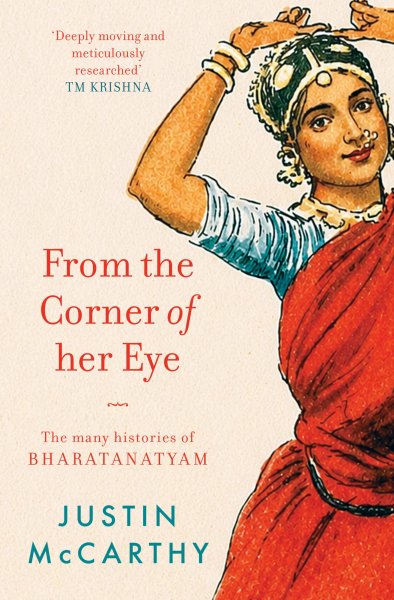 The book is not a comprehensive encyclopedia of every female dancer associated with chinna melam, a task perhaps best left to historians. Thankfully, Justin McCarthy does not position himself as a historian, but as a concerned dancer who sees a "collective amnesia" among dancers and recognizes the many misconceptions surrounding the women who practiced the form. Rather than merely presenting a long list of dancers, McCarthy takes us on a journey from the mythical Madhavi to Veenabhashini, offering multiple vantage points from which to view this complex history. Each perspective incorporates facts backed by old and new scholarly research, while also considering their sociological significance with a welcome degree of objectivity. In many instances, he does a good job of dismantling familiar myths. For example, he writes, "...we cannot, and should not, imagine that the dance described in Natya Shastra is the same as present-day Bharatanatyam". This is an important distinction. In dance classes, when the origins of the form are discussed, there is often a tendency to extrapolate the present form into the past and, in the process, glorify its antiquity. The karana sculptures are a good example and is also mentioned in the book. It is tempting to look at their costumes, jewelry, and poses and see in them as a linear progression towards the Bharatanatyam we know today. The process, however, may well have worked the other way around. The current form was superimposed upon the sculptures and parallels were subsequently established. Moreover, these sculptures were created centuries after the period in which the Natya Shastra is believed to have been composed. What we have, therefore, is a mixture of evidence and speculation about how dance might actually have been performed in the time of Madhavi or Ilango Adigal. The book brings these contrasts in dance history to larger extent, that raises introspective questions in the reader rather than giving readymade answers. Throughout the book, the author also points to the coexistence of other dance traditions alongside chinna melam and the strong possibility of interactions between its artistes and those performing forms such as koothu and Bhagavata Mela. This syncretic existence has often been conveniently forgotten or, so to speak, brushed under the carpet. Class and caste played an important role in determining which traditions were remembered, which were marginalized, and which eventually disappeared from dominant narratives of dance history. There is another important dimension to this argument as emphasized in the book. For every successful woman dancer of chinna melam for whom we have abundant evidence, there were many others who supported, assisted, taught, accompanied, and participated in this artistic world, but whose contributions have gone unsung. The author repeatedly emphasizes that this community of women dancers needs to be understood as a thriving artistic community, rather than through the elevation of a single dancer as representative of an entire era. Journeying in a broadly linear historical fashion, the author takes us through the many transformations of chinna melam, the forces that shaped and reshaped it, and the often-embattled process through which the current form of Bharatanatyam emerged. In each chapter, he brings together the beauty of the dance, historical facts, and a balanced sense of nuance, without falling into the trap of hagiography. All thanks to recent scholarship that brought more facets to the history. What the book asks of us is an acknowledgement of the complex and often non-linear history of these women and their performances. It also reminds us that even well-intentioned attempts at "reformation" had disastrous consequences for many women dancers, who lost both their professional standing and their ritual status in society. If you are interested in dance history, this is a balanced and accessible book, with its arguments supported by ample research. At the same time, the writing remains simple enough for someone who is only beginning to explore the complex history of dance and the prominent place it once occupied in the cultural psyche of South India. The gendered nature of the reform movement, particularly the targeting of the dancer rather than the dance itself, is something that requires a deeper understanding of the history behind the form we see on stage today. At a time when Gen Z seems to spend more time doom-scrolling than reading, this book is a welcome addition. I hope more young people will read it and explore the multifaceted world of women dancers, not only in southern India but also in other parts of the country. One thing we should certainly not do, as the author repeatedly reminds us, is generalize about these women, their lives, and their circumstances. In his words, "What was true for one dancer...would not have been true for another dancer..." and "not every girl in a family was singled out for the life of a dancing woman". These observations are important because they resist the temptation to reduce a diverse community of women, separated by time, place, class, caste, and circumstance, into a single convenient narrative. At the end of the book, one is not left with a melancholic view of a bygone era. Instead, one is left with an introspective question: how do we reconcile the complex past of the dance with its present? Perhaps that is one of the most valuable things this book accomplishes. It asks us not merely to celebrate or condemn the past, but to understand it. Postscript: I think it is slowly becoming common for publishers to remove endnotes from the printed book and provide them instead as an online appendix. I understand that this probably makes sense in terms of reducing printing costs. As a reader, however, I found it a little jarring not to be able to consult the notes immediately and to have to rely on an online resource to accompany the book. I am also not a great fan of translating nouns and specific terms into generic English equivalents phrases that can be difficult to remember and follow. This seems to be increasingly common in popular and public history books, perhaps with the intention of making them more accessible. For me, however, it sometimes has the opposite effect. The original term often carries a specificity and context that a descriptive English phrase cannot quite reproduce, and replacing it can reduce rather than enhance the impact of the writing.  Dr. Ragothaman Yennamalli is a student of Bharatanatyam. Post your comment Please provide your name / email id when you use the Anonymous / blog profile to post a comment. All appropriate comments posted in the blog will also be featured in the site. |
