
|     |
|
| |

BOOK REVIEWKathakanugaman- Vijay Shankere-mail: vijaydance@gmail.com May 13, 2026 Kathakanugaman Bilingual book - English and Marathi By Maneesha Sathe Bookmark Publications, Pune Price: Rs 450 Pune based veteran Kathak exponent and mentor Maneesha Sathe has written a very interesting book in two languages, 'Kathakanugaman' in English and Marathi, in order to maintain regional flavour, ethnic quality and also to cater to the international audience with a holistic perspective. It traces the journey of the dancer, whose invaluable and outstanding contribution in the promotion and propagation of Kathak dance on the global platform, spans more than five decades. Published by Bookmark Publications, Pune, Kathanugaman spans 180 pages, inclusive of the glossy cover featuring Maneesha Sathe in a beautiful 'thaat' (pose). It is dedicated to her parents, Manyabapu and Vimalabhai Sathe, mentor Pt Gopi Krishna and Rajas Sathe with lots of photographs that visualises the divine journey that started as a little girl to her phenomenal growth as a teacher, performer and choreographer and the listing of 45 students who have risen to become professional performers and mentors, a fruitful and substantial journey indeed. 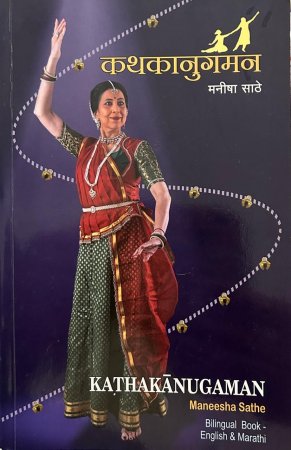 The Kathak journey of Pandita Maneesha Sathe stands as a testament remaining rooted in tradition, while persistently exploring new dimensions. This writing unfolds the treasure of her experiences, revealing the harmonious blend of her long standing study, rigorous practise, reflective insight and pedagogical maturity. Teaching at Maneesha Nrityalaya transcends mere instruction; it becomes an act of cultural preservation and transmission. Learning is not about just mastering an art form -it's about connecting with its very soul. This sentiment resonates through each page. A book that sparks thoughts among connoisseurs of Kathak, serves as a guiding light for emerging artistes and stands as new beacon in the Guru-sishya tradition. The book traverses through fifteen chapters, commencing with Maneesha Sathe as the torch bearer of Kathak, Preface, My Dance Education, The Gurukul Tradition, Qualification of a Dance Teacher, Teaching Dance in Practice, Mentoring Abhinaya, The Importance of Riyaaz (practice), Thoughts on Dance Choreography, Changing Times, Dance and Varied Career Opportunities, Kathak Dance Style and the Role of Shastras (theoretical framework), Beyond the Stage- Nurturing the Dancer Within, A heartfelt yearning from Within and lastly the Golden Jubilee of Maneesha Nrityalaya. The author states, "This book is not my autobiography but rather an exploration drawn from my own experiences of the various questions and challenges my students have encountered while learning Kathak. Therefore, this book does not intentionally delve into the details of my performances, my choreographic experiments or my innovative compositions. I intend to develop a separate book covering those aspects". Pt Gopi Krishna was a legendary Kathak dancer and mentor. He was the grandson of Pt Sukhdev Maharaj. At the age of six, he was awarded the title of "Nataraj" at the Kolkata conference and it was through the 1955 film "Jhanak Jhanak Payal Baje" in which Gopi played the lead artiste, that Kathak entered every household as a popular classical dance form. As a little girl, Maneesha arrived from Pune to enrol as a student of Pt Gopi Krishna. Maneesha says, "I went to Gopiji's class in Mumbai with my parents at the appointed time. In Khar, Mumbai, the classes were held on the ground floor of 'Nateshwar Bhavan', while Gopiji lived on the upper floor. I had already watched one of Gopiji's captivating performances in Pune. But I was too young to be afraid or intimidated by his stature and fame. So, when Gopiji asked me to perform something, I confidently presented a farmishi chakradhaar paran in tritaal that I already knew. From the next day, Gopiji called me for morning riyaz (practise). While teaching dance, Gopiji always taught in very fast tempo (laya). He never approved of teaching in a slower tempo. The weaving of bols like "Tram tigda digdig thai" had to be done in such a rapid tempo that it was almost impossible to even recite them clearly, that's what he expected. Every student was required to dance in that tempo. Through dedicated riyaz, each student had to internalise that speed. Gopiji was insistent about this. He never explained things clearly or explicitly. That was not the method back then, nor was there an atmosphere where students felt encouraged to ask questions. Because of this, often, we didn't know the compositions we were learning. Was it Gopiji's own? Or did it belong to our pakhawaj accompanist Ram ji bhaiya? Or was it from Pt Sukhdev Maharaj ji? Which Kavits have been written by Pt Sukhdev Maharaj? Which compositions were traditional? Had this information been communicated to us back then, it would have greatly enriched our understanding and awareness as disciples". Pertaining to the Gurukul tradition, Maneesha states, "Earning the Guru's trust and fulfilling their artistic expectations through dedicated practise is the students' responsibility and test. Likewise, identifying the right student is the Guru's duty. In this way, I believe the Gurukul system and the Guru sishya tradition will evolve and thrive". Ultimately the teacher's success lies in maintaining discipline and principles. Without compromise, while still communicating effectively with parents and guiding students with care. Regarding abhinaya, the author says, "I do feel expressive ability must be innate to certain degree, but it can undoubtedly be cultivated through training, repetition, self-observation and deep reflection. One must train the facial muscles to be relaxed and expressive. The more naturally expressive the face, the more convincingly the emotions are conveyed to the audience. At the same time. the dancer must have total clarity of the meaning of the poem, its characters and the mood of the composition and the sequence of abhinaya to be performed. When mind and body are fully aligned, genuine emotion flows to the face and from there to the hearts of the audience". In the chapter on dance choreography, Maneesha opines, "Kathak dance choreography is a mindful and layered process that harmoniously weaves together rhythm, melody, poetry and expression. It demands an understanding of the dancer's capabilities, the nuances of the musical compositions, thematic depth and stage aesthetics, ultimately creating a visual poetry, where tradition meets creative interpretation. Kathak dance choreography is thoughtful blend of artistic vision, musical structure and performer readiness - where every movement, rhythm and expression is purposefully crafted to bring a concept to life on stage." An unusual and unique aspect of the book is the chapter 'Dance and Varied Career Opportunities' where the author draws your attention to thirteen different segments or careers like the significance of the dance critic or dance writer, make-up artist, costume designer, stage and event management, assistant choreographer, photographer and videographer, lighting designer, sound engineer, music recording and composition, lyricist, administrative and financial management, dance therapist and academic teaching. Guru Maneesha Sathe has especially garnered recognition for her pioneering collaborations with Japanese music, creating a unique dialogue between Indian classical dance and global traditions. Her long-standing partnership with Japanese musicians and Taiko drummer Yasuhito Takimoto has resulted in a series of unforgettable fusion concerts over the past 25 years. Productions like the 'World Peace Art Festival' and 'Divine Confluence' stand out as iconic milestones of this international collaboration. These choreographies represent a vibrant confluence of traditional Kathak, contemporary soundscapes and the dynamic rhythm of Taiko. Over a hundred Indian, Chinese and Japanese artistes have participated in these events held across India, Japan and China. The last page has listed 45 students of Maneesha Nrityalaya who have turned professionals like Shambhavi Dandekar, Poonam Gandhi, Tejaswini Sathe, Madhuri Apte, Isha Kathavate, Prajakta Dravid, Purvi Bhat, Uttara Bhave and Nandini Kulkarni to name a few. Maneesha concludes with, "Grant wisdom to the seeker, destroy all ignorance, bestow every accomplishment through your eyes". 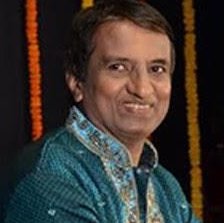 Vijay Shankar is a Kuchipudi and Kathakali exponent, teacher, bilingual journalist, arts critic and actor. Post your comment Please provide your name / email id when you use the Anonymous / blog profile to post a comment. All appropriate comments posted in the blog will also be featured in the site. |
