
|
    |
|
|
|


Leela Venkataraman - Ananda Shankar Jayant, Hyderabad e-mail: anandasj@rediffmail.com December 18, 2009 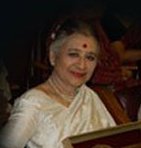 Leela Venkataraman's career as a writer on dance began as the Dance Critic for the National Herald in 1980, after which she was with another daily, The Patriot. Selected as the Dance Critic for The Hindu when the paper began its Delhi edition, she has been with the paper ever since, her Friday Review column earning a reputation for being the most incisive commentary on the dance scene in the capital. Widely traveled in India and abroad, she has participated in seminars and dance events like the international Seminar on Bharatanatyam in the Diaspora in Chicago, the North American International Dance Seminar in Houston in 2001, the Binnels de is Danse at Lyons in 2000 and the Rukmini Devi festival in Malaysia. Leela Venkataraman has written extensively for journals in India and abroad, and is on the Delhi Bureau of Sruti, a monthly journal published from Chennai. She was also on the Board of Management of the Kalakshetra Foundation for a full term. Among her publications are 'Indian Classical dance: Tradition in Transition,' 'Bharatanatyam: Step by step' and 'A Dancing Phenomenon - Birju Maharaj.' Young Gurus... is it an anachronism? What are the checks and balances that are needed, when young performers take to teaching dance? Whether an anacronism or not, this is going to be more and more frequent in the dance world of today, for the simple reason that performance space is limited with too many dancers wanting opportunities and in such a situation, most youngsters, particularly males who need to support themselves will take to teaching as the best means of earning a livelihood. Teaching can and often will be looked upon as a stopgap arrangement till recognition and chances for performing increase. Unfortunately, institutions rarely specialise in teaching courses and awarding diplomas for graduates who pass the course. If a diploma in teaching becomes the only route to starting training classes, one may be assured of some standards. On the other hand, teaching should be encouraged for it can be a way of improving oneself. Teaching can be a wonderful way of learning for the teacher because one has a more leisurely look at movement as it is made to sit on other bodies and one begins to understand more about the dance form and the body and how energy works as one moves. But this is only for the observant teacher. A very self centered person may end up by just adding to the general mediocrity. If only one could have established institutions teach the craft of teaching, with diplomas, one may atleast be assured of teachers who will not harm the over all dance level. Very often for young dancers who suddenly find themselves having to live abroad, teaching is the best way of keeping in close touch with the dance, which in another country may be totally out of context. It would be correct for young 'gurus' to know their limitations and to teach only what they are absolutely sure of and know will meet with any senior Guru's approval. Not trying to be knowledgeable about what they do not know, would be safe. And the way the word 'guru' has been devalued is sad. Every person who has half a dozen youngsters to teach becomes a 'guru'. Guru is a loaded term and one should not use it lightly. With dance schools mushrooming exponentially, and performance spaces shrinking just as fast, how does the next generation of dancers, handle this paradox? Unfortunately in India, we have stressed the performance part of dance to a point where research and scholarship in dance and using dance for other very fruitful and beneficial ends has been totally neglected. Not every person who learns dance has the inherent ability or qualities needed to be a good performer. Using dance as a tool for education can be a very fulfilling vocation. I remember Contemporary dancer late Narendra Sharma talking to me about his dance training under Uday Shankar at Almora. When he voiced an opinion of not having either the face or the figure for the stage though having a flair for the art form, his guru Uday Shankar told him, "Discover what suits your personality. It may be a very different type of dance." And indeed this is exactly what Narendra Sharma set about doing. His wonderful productions like 'Antim Adhyaya' on the story of a graveyard or 'Conference' which was a satire on how official events are staged, or even 'Wolf Boy,' the story of a child brought up by a she wolf, had no star roles. The group endeavours called for a great deal of participation and in the process of thinking of these new ways of looking at dance, Narendra Sharma evolved as an artist. He joined Modern School in Delhi as a dance teacher and what he achieved in terms of growth as a teacher, and educating children about movement and understanding how the child's mind works, along with his productions, made history. He boasted that anything could be made to dance - and his joy in life had come not so much from performing as from working with kids and arriving at ways of 'making dance out of everyday movements.' There are persons like VR Devika and others working with dance in education. In Delhi, Sallaluddin Pasha gave up ambitions of being a star performer when he discovered what dance could do as therapy and as a way of life for the handicapped. Body and speed seems to be the new mantra of classical dance, competing as it does for eyeball space with reality shows and spectacular films. How does one retain the quintessence of the art form? Yes this is a reflection of the times we live in. Nothing is slow and leisurely and just as the vilambit pace is dying out in every sphere, it is vanishing in dance too. And it is easy to win instant applause with speed. One reason why I thought Chandralekha was doing yeomen service was her steadfast motto to slow down the pace of movement. Speed is fine while the body is young. But as one begins to feel the impact of the years, one will be sad to realise that one has not allowed the inner dancer to evolve thereby bringing to one's dance that strong something which cannot be wiped out even when the body is not as agile as it was. Refusing to rely on speed requires courage and hard work for one has to learn to hold the audience attention without gimmicky speed. How much of Shringara is enough? Where does one draw the line? How can one draw a line specifying this? Just as there are dancers who think of sringar in bhakti, there are also those who think of bhakti in sringar. I feel that it is the dancer's good taste and sensitivity in being able to communicate the message that matters. I have been witness to the same lyrics being treated in opposite ways by two dancers - one projecting a total immersion in devotion while the other portrays an unabashed erotic message. It is like choosing between Bala and Rukmini Devi. Both were rivetting and great in their own way. It is part of the artistic license to leave interpretation to the dancer. And ultimately sringar, bold or contained, should come from the inner dancer and not from sheer physicality or titillation. Dance is the art of suggestion. Done with aesthetics and conviction, for me any approach is fine. More than 'what' the 'how' is important. With dwindling space for dance writing in the mainstream media, and a younger breed of writers, blogging and tweeting, what do you see as the future of dance writing? Dance writing has reached low standards today due to several reasons - not least the fact that nobody seems to be interested in scholarship and learning in the writers and their statements on dance. Personal scores are settled through writing columns and where is the integrity when the writer, who lavishly praises whether warranted or otherwise, and the praised, form a pact in which the honest writer has no place? Few papers insist on quality and in-depth writing and dance scholarship is at its lowest ebb in the country. Papers want sensationalism and even the average reader does not insist on a measure of honesty. Why cannot our readers respond by writing to the editor about what they feel about the critic's writing? If they are dancers, they want to play safe. The response only comes when dancers with clout as high profile members on various committees try to promote those who are given to flattery in their writings - raising their voice against those who have dared to criticise them. With our artist community so allergic to any type of criticism, how can the quality of dance writing improve? Where is integrity and objective writing? Everyone at every level seems to have an agenda other than the improving of standards, when it comes to dance writing. Is it a surprise if the honest writer feels cynical about what is happening? Contact: leelakaveri@hotmail.com |
