
|
    |
|
|
|


Ramli Ibrahim - Kiran Rajagopalan, Chennai e-mail: kiran.rajagopalan@gmail.com December 10, 2009 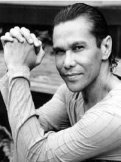 Ramli Ibrahim is a dynamic force in Malaysian theatre and possesses open-mindedness for both the Old and the New. Trained in classical ballet, modern dance and Indian classical dance, Ramli is a creator and a visionary in the arts who sees unity within the diversity of all of Sutra's artistic endeavors. Recipient of the Fulbright Distinguished Artist Award 1999 and the coveted BOH Cameronian Lifetime Achievement Award 2003 and the JSM (Johan Setia Mahkota) 2004, Ramli Ibrahim is Malaysia's most prominent dancer and choreographer. Acclaimed as a potent dancer and choreographer himself, Ramli has achieved an impeccable mastery in Bharatanatyam, Odissi and contemporary dance. Ramli studied Bharatanatyam under Adyar K Lakshman and Odissi under the late Guru Deba Prasad Das. As Artistic Director of Sutra Dance Theatre which he established in 1983 at Kuala Lumpur, Ramli Ibrahim has always envisioned his creativity as a total experience, one that transcends national boundaries. For Ramli, theatre is the all-encompassing universal vehicle for his creative vision: it expresses life itself in richness of all the myths and rituals. Odissi dancers of Sutra have the respect and acclaim of dance connoisseurs. Although you started your career as a professional ballet dancer, what first sparked your interest in Bharatanatyam and Odissi?' From the very beginning, my approach to dance has never been linear. I began learning Malay traditional dances, but even during my younger days I was exposed to Indian dance in Malaysia's multi-racial society. When I started formal training in ballet and modern dance in Australia, I was introduced to the scientific method of the training of a dancer. I was attracted to Bharatanatyam and later to Odissi as I was seeking the most comprehensive form and vehicle for the solo dancer. The total involvement of the Indian classical dancer from the physical, emotional, to the spiritual is the ultimate challenge for me. The Indian classical dancer has a total command of the stage. I was also seeking the mother lode of knowledge of which India is a source. I welcome the idea of submitting myself to a tradition after the experiments that I had to go through in Ballet and contemporary modern dance. All these I experienced simultaneously. 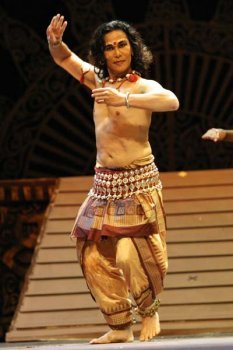 Has your background in ballet, modern, Malaysian folk dance influenced your vision of Indian classical dance? Are there elements from these styles in your Odissi choreography? First of all, one must understand where one stands - whether one is functioning within a tradition or outside of it. I happen to function in both situations - as an Indian classical dancer and as a contemporary modern choreographer and dancer. Whether one likes it or not, one's vision and reaction is always the total sum of one's experiences. I'd like to think that the influence has been positive where Indian classical dance is concerned. If you look at any discipline or any tradition, one sees a dynamic evolution that results from the cross-fertilization of ideas and interactions. As a contemporary modern choreographer, my works are influenced by Asian traditional forms, especially Indian dance. Generally speaking, I am not that interested in composing traditional works. As a solo Odissi or Bharatanatyam dancer, I like to dance the 'classic' repertoire of traditional gurus. In group compositions, my influence is in the rearrangement and use of space. I do, however, influence the artistic direction of works I commission, especially in Odissi, so that aesthetically, the commissioned works conform to the particular direction that I desire. In my contemporary modern choreography inspired by Odissi, I go all out to use whatever there is at my disposal to achieve my choreographic vision. But these works which involve choreography, may I remind the reader, are contemporary modern works which are inspired by Odissi and don't belong to those accepted as traditional Odissi pieces. Having said that, I realise that there are works that are ambiguous and are a bit difficult to define. They may be in the genre of neo-classical works which are very modern in its compositional approach. This is not a strange thing if we consider that even the items in traditional Odissi repertoire themselves are relatively recent constructions. Sutra Dance Theatre is truly a model arts organization in that your ensemble and institution are both exceptional. What are the challenges of starting and maintaining such a large arts organization? Is it possible for arts organizations to thrive with little government and public support? I am amazed and flattered that Sutra is considered a model arts organisation! Our major challenge is not artistic but funding so that we can continue being creative and doing what we love to do! First of all, Sutra is not a large organisation at all. There are many other organizations, especially in the US, Canada, or even UK, which are highly funded and considered truly professional organisations. Increasingly I realise that proportion is important and we survive because we are small, versatile and, therefore, able to evolve with the times. I am always aware of the creative impulse and the challenge is to be able to tap this elusive phenomenon - this precious impulse may spring up within the smaller confines of the studio while creating or interacting with dancers or even with parents or on the larger societal milieu of interacting with the other makers of arts. One of the major challenges is to continue being creative and relevant within these parameters. It is actually possible to survive with little governmental support, and let's face it, the most reliable arts supporters are the artistes themselves or friends of the arts. Sutra survives because we strive to be excellent in what we do, and the public come to our performances. And of course, there are sacrifices too numerous to mention. Sutra Dance Theatre features talented dancers from different backgrounds. Do you think Indian classical dance has a global reach as reflected by your ensemble's diversity? I always believe that good art finds its own level. It does not recognise race, religion, or gender. All good art has the potential of a global reach, and it is one of the triumphs of India that Indian classical dances (like yoga and even Bollywood) are able to reach out to international audiences. Sutra's multi-racial dancers are a symbol of Malaysia's present political slogan of 'One Malaysia.' In Sutra, we've always had an open-door policy and we exemplify creative freedom. We are not into promoting any cult movement. We simply believe that the arts are important in nation-building and the empowerment of the individual's creative potential. At the same time, our passion is in 'serious' art rather than the commercial. You are collaborating with Geeta Chandran in the segment titled "In Conversation: Stretch Marks." Is this your first time working with her, or have you both collaborated before? I have been a great admirer of Geeta and have seen her works in New Delhi. However, it's the first time we are sharing a platform though it is only in the form of an exchange of ideas and conversation. What is one thing you like to do while visiting Chennai that can only be done here? Chennai has become an exciting cultural city to be in especially at this time of the year. It has also lost its previous 'frumpiness' and is now fashionable and more relaxed. There is a lot of catching up that one can do with friends, old and new - networking, planning and even exchange of gossips as one is bound to meet friends and be engaged in many interactive encounters. Yes, I find Chennai is 'engaged' in December. It is sort of the 'Frankfurt Fair' of Indian dance and music and it is delicious to be swept by it all. Contact: sutradancetheatre@yahoo.com |
