
|
    |
|
|
|


Ashish Mohan Khokar - Kiran Rajagopalan, Chennai e-mail: kiran.rajagopalan@gmail.com December 10, 2009 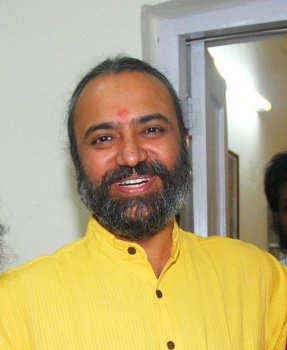 As successor and inheritor of Mohan Khokar's work, Ashish Mohan Khokar continues to serve dance. Thanks to the wealth of materials left, he has been able to do 35 books and edit-publish 'attendance,' India's only yearbook on dance and its history. He also served the Sahitya Kala Parishad; Festivals of India in France, Sweden, Germany and China and Martand Singh Consultants before becoming a full-time dance writer serving the Times of India as their dance critic for two decades and many magazines and journals, including narthaki.com. You have trained extensively in various Indian and western classical dance styles. What compelled you to become a dance-historian, critic, and writer instead of a performer? I was too shy to be on stage! That's the most truthful answer. In my formative years, I was also surrounded by many, many great artistes at home and around in our immediate environment, as both my parents were leading lights of the dance world. Gurus, legends, top dancers came home and often stayed with us. So seeing them and their great art, I felt humbled and dwarfed. The shyness did not help, and my parents never encouraged me overtly. My mother and her mentor Ram Gopal were very indulgent, and they loved my dance and laughed at my gimmicks, all dressed up in their costumes! Father was a silent spectator. Padma Subrahmanyam recalls my childhood dancing days fondly and once said few years ago, "Why don't you dance? Anyone can write!" Chandralekha once said, "You have a dancer's gait when you walk, why not dance for me in my productions?" My impromptu "arangetram" took place right across from this NKC venue, in T Nagar, at Guru Vempati's Kuchipudi Academy, sometime in December 1975. I was just fifteen then. Dr. V. Raghavan, my father and mother, Vempatiji, and the beautiful male dancer Kamadeva were in attendance. While they all made feeble noises after I danced an item or two, none of them said much. So I must have been awfully bad; hence, no one asked me to continue or dance again! Another limitation was that most gurus were known to my parents, and they have a family-like relationship with them. So no one took any fees; hence, they also were not very accountable and came irregularly! Ten years went by, and I learnt hardly a margam and was still counting ek-do-teen-char in Kathak! The Odissi guru gave up after a month saying I had no hips for tribhangi to show! All in all, it was a perfect recipe for not becoming a dancer. But learning three forms and western ballet from Marianne Balchin of London in 1971 helped me understand each form intrinsically for later, as a writer and a budding critic. After school and college, I had three career options having unfortunately done very well in studies: take the civil services exams, dance, or do arts management. I am self-made totally, as my father was very strict and would not help me professionally. So I struggled and did odd cultural jobs. After 10-12 years of wide cultural exposure, I came to dance because my father one day lamented: "You are serving and saving Indian culture nationally and internationally but not the one main monument at home” (meaning him and his dance collection). That single line made me give up all I had built on my own in arts administration, and I took to dance writing and documenting full-time. Providentially, the same year, the Times of India in Delhi was looking for a younger dance critic, and I arrived on the dance writing scene nationally in 1990 after 15 years of doing arts administration. I wrote for the Times for 10 years, and then later for 2 years in Bangalore. However, I had written stray columns for Hindustan Times since 1985. I am now a full-fledged dance writer, critic, historian, and editor-publisher. Writing dance is in my DNA programming, and now my life is solely about saving and serving dance history. I did not plan anything; the universe gave me that role and responsibility. Honestly, Goddess Saraswati has been very kind to me and Laxmi too smiles from afar. All gods have blessed me, hence my name Ashish! What are the challenges of maintaining a large archive like the Mohan Khokar Dance Collection in India? What can be done so that valuable collections are preserved for future generations? The challenges are just too many for an individual. Being shy, honest, frank and true to the art are all bad combinations in India! Yet, the gods have been very kind. Somehow we have managed. The Mohan Khokar Dance Collection (MKDC) is the painstaking work of my father Mohan Khokar, who diligently collected and built it for over 70 years, and I have done all that could be done to save it and keep it intact for the last 30 years. My mother too suffered a lot for it. We three have put all of our earnings and a lifetime's work into it. It is now beyond the ability of one individual, no matter how strong, gifted, or committed. It needs urgent institutional support. Having tried donating it to many national institutions, I still have not found the collection a proper home. Donations are not taken seriously in India. There is no accountability. The MKDC contains not just archival material but artifacts, costumes, masks, and crafts. Gurus from over three generations have given us letters, pictures, and books. Many dance legends have gifted personal effects. We cannot now physically accommodate all these things. It cannot fit into any existing institution; an institution needs to be built around it. I did not want to create an institution because my best years would have gone into just managing that and not doing real field work for books and biographies. Giving it away to a deserving institution has its pitfalls because they may not have the same sense of commitment to dance history. The security and safety and proper use of historical materials is paramount. Keeping the collection and augmenting it, is a perennial challenge and I'm doing my best to save it from many elements for future generations. The MKDC is in dire need of conservation, preservation and computerization so that students, Ph.D researchers, new critics, and writers can benefit. Digitization would help reach the collection to more people now that we have great technology at our command. The MKDC is the nation's wealth. As an experienced arts administrator, what are your thoughts on the extent of arts education in India? Should artistes be encouraged to enroll in courses on arts management and/or business? Zilch! Arts education is a fluffy, unplanned field with no real courses or qualified people. Many schools and NGOs make money and get grants, but what is the output? Artistes cannot be managers nor can they be reduced to being administrators. They are creative folks who need to be on stage, immersed in their art, and not sitting and performing administrative tasks. In India, dancers have to do everything themselves, and that is rather sad. Market economy also dictates, and dance does not pay much (because most shows are not ticketed). Therefore, how can a dancer hire professional help? India needs a special cadre within the civil services to address arts administration. Dancers should be left to do creative work. Many institutions have collapsed precisely because, artistes have had to manage them in addition to their creative output. The two are not easily doable or compatible. Writers should write; dancers should dance; managers should manage. The mixing of all these roles nowadays is one chief reason why we have no focus or excellence in any given discipline. In addition to performing, how else can young dancers help promote the classical arts? Young dancers are mostly "educated" and market-savvy now, so they can do lots to articulate. But they must also look beyond their noses and serve dance art as a whole, and not just themselves. How many buy dance books unless featured in them? How many take up some social cause in their immediate surroundings, by which they can integrate their art with life? Young India is soon going to have a serious disconnect with our traditions. So dance and music are the bridges they would need in the future to reconnect. While Indians may lose it, the NRIs are trying hard to hold on to it and are doing it more sincerely. It is up to dance teachers, parents, and organizers to mould the young. I'm told this year's NKC dates have been shifted to suit the young, who have holidays at the end of December, to attend and learn. Let's see how many do. What is your favourite fiction or non-fiction book and why? My favourite fiction book is Rohinton Mistry's 'Such a Long Journey' because it is a very sad, yet inspiring story of human relationships. It is about a simple man who suffers much and still smiles through life. It has poetry on each page and is an extremely very well-crafted book. Rohinton Mistry is my absolute favourite author. Dag Hammerskold's (Swedish super diplomat and former head of the U.N.) book, 'Markings' (essays on philosophy and godhead), is also the most meaningful, non-fiction book for me. Dance is my DNA; spirituality is my true calling. Contact: khokar1960@gmail.com |
