
|
    |
|
|
|


Kumudhini Lakhia: Brilliant innovation within the traditional structure - Sunil Kothari e-mail: sunilkothari1933@gmail.com April 27, 2009 Sunil Kothari in conversation with Kathak dancer, guru, choreographer Kumudini Lakhia 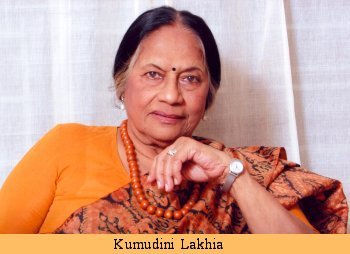 During Kumudini Lakhia's more than a month's stay in March 2009 in Delhi for the assignment of choreographing a new work titled by her as 'Punarnava' in Kathak for Kathak Kendra's repertory, as a guest choreographer, we met often at the Kathak Kendra, whenever I got an opportunity to watch the rehearsals, a privilege, she granted affectionately. It has been indeed a privilege to have known Kumudini Lakhia for more than 50 years. I have very happy memories of meeting her during the All India Dance Seminar convened by Sangeet Natak Akademi in April 1958. In the evening at Talkatora Gardens, performances were organized. Bharatiya Kala Kendra had mounted Malati Madhav, a dance-drama, based on Bhavabhuti's classic, choreographed by Lachhu Maharaj, with music by senior Dagar Brothers and sets and costumes were designed by Naina Devi. Krishna Kumar had played the role of Madhav and Kumudini as the heroine Malati. Young, with an arresting stage presence, she had charmed away the audience! She was studying under Shambhu Maharaj in those years under government scholarship and had moved to Delhi, staying with Sumitra Charatram. Those who have seen her later on in a duet with young Birju Maharaj, as Rati and Kamadev in 'Kumar Sambhava' dance-drama, still recall how they danced complimenting each other's dance. Ah, those were the days! Kathak as a dance form was coming into its own in the Capital. In those years it was Bharatiya Kala Kendra which was nurturing Kathak. Kathak Kendra was established later on and till it moved to its own premises, the classes were held at Bharatiya Kala Kendra premises. Having returned from London after partnering the legendary Ram Gopal, Kumudini settled in Ahmedabad with husband Rajani Lakhia, who hailed from a well-to-do business class Gujarati community. He was studying Law in London and also assisting Ram Gopal for music. Kumudini and Rajani Lakhia met during those years and got married. Kumudini was exposed to the best of the world class ballets and dance performances in Europe and being perceptive, multi-talented with interest in literature, music, painting, theatre and dance, touring with Ram Gopal, she imbibed the art of choreography taking part in Ram Gopal's company. She acknowledges with gratitude her learning under Ram Gopal and rare opportunities she got abroad to dance and observe various art disciplines in those formative years. If today she is hailed as a great choreographer of India, this background has to be remembered. Indeed her own gifts as a visualizer have placed her in a class of her own. One morning around 10am, I arrive at the new hall built at the back of Kathak Kendra in a compound where National School of Drama also occupies a lot of space. All repertory dancers are there in time as is Kumudini. I did not want to be late to see the creative process. It gives several insights to a critic/ dance aficionado for appreciation of a choreographic work. The conversation took place over several meetings. Few excerpts from conversation: Sunil: The new hall built at Kathak Kendra provides good space for new work. Kumudini: Yes, indeed. It is always inspiring to work in such spaces. But you also make it yours. If I do not see shoe racks, I get them ordered, see its design, and plan to keep the place clean. This is also a part of choreography, for when you enter a room for rehearsal, it must give you good vibes. Sunil: What prompted you to accept this assignment of choreographing the new work? Kumudini: A challenge, Sunil. If I am now seventy five plus, and have a certain vision about Kathak, working with young Kathak dancers, well trained at Kathak Kendra and members of a Repertory, it gives me an opportunity to explore Kathak with freshness. I wish to see Kathak at the top, wish to place it very high in the esteem of people, dancers, and musicians. Having spent my entire life in mastering, teaching, dancing and choreographing works in Kathak, I still visualize that there is so much potential in this dance form, which can be explored. And not only that, but also to show to young generation where they have to go. Kathak Kendra has started a repertory unit engaging dancers on a regular professional basis, so the productions of Kathak Kendra can travel with new choreographic works. I am delighted that they have invited me to choreograph a new work, and my choreography will be in their repertoire. Sunil: What has been your concept and what have you selected as a theme? Kumudini: Simple. You know how all we Kathak dancers learn Bindadin Maharaj's song 'Niratata Dhang.' It is an amazing song and is known as 'Lakshana Geet,' as it contains salient features of the Kathak dance form. Bindadin Maharaj has penned it beautifully with his devotion for Krishna and Radha. I thought why not take this song as 'a peg' and around it explore Kathak, its technique, both in nritta and expressional aspects? That thought haunted me for a long time. So I started working on its various components. Sunil: You have worked with Atul Desai who has composed music for your choreographic works. Kumudini: He is not keeping well and cannot undertake such a strenuous work. Therefore Madhup Mudgal was invited to compose the music. We had an initial meeting and we worked out the basic approach. Sunil: You know, Kumudini, this song has been embedded in the memory of an entire generation with specific tune like an archetype. Would you and Madhup-ji succeed if you plan to temper and change the basic tune and raga? Kumudini: Your apprehension is correct. In the beginning Madhup-ji also was hesitant. My observation was simple. Do we not change toda and tukda? And present it within the traditional format? But we change them, without losing its characteristic quality. So suppose we change the raga and the tune, it would still retain its basic quality. Sunil: Yes, I was with you and him when this was discussed. But I do not know how it would work? Kumudini: Wait and watch and listen and see it. I wanted every stanza to flow into the next in a seamless manner, coming back to the refrain: Niratata dhang. For example, the stanza beginning with 'Brajbhana nandini,' I wanted it as a thumri, as thumri is a part of Kathak and Madhup-ji set it very beautifully. Not only that, when Radha is in ecstasy she dances losing sense of everything, in circles and circles. I have imagined her like that. So within the traditional structure I attempt to innovate with imagination, keeping the mood and temperament in tact. I think I can create something which is fresh, novel, not seen earlier. Sunil: You are known for contemporary relevance in dance, more so in Kathak. If you again handle Radha-Krishna theme, how would you get away from mythology? Kumudini: It is a wrong notion that whatever I do is innovative and contemporary. Of course, my approach is contemporary. I am extremely fond of tradition as it is my solid foundation. I can build upon it, take its support, but I must have originality and an ability to make it look so refreshing that people would forget it is traditional and yet it has to retain those components which are traditional and time-tested. If you were to read the poem it deals with Radha Krishna watching Yamuna flowing. They are in an idyllic atmosphere with gentle, fragrant breeze, so many gopis are there. Look at the musicians - who are they? Brahma, Narada, Shringi, Shambhu - what an orchestra, and what does Lord Shiva wear? Crescent moon and from his matted locks flows Ganga. Now all what we call cosmos is there. There is immense scope for using Dhamar, and also Tandava. Former scene I can compose in lasya, in a gentle mood and create contrast. That, a choreographer has to imagine, organize... Sunil: Did the young members of the Repertory offer suggestions? And work as a team? Kumudini: I create that spirit as a choreographer. Take them into confidence. Ask them to demonstrate, recall a toda, a paran, a movement - move in this manner, go in a quick tempo, align, form a pattern, a pattern for movement to fit in for the music Madhup-ji would compose. As you have seen, we have a lot of fun also, as much as we do the hard work. Sunil: I saw during one of the rehearsals, boys walking, marching like soldiers, charged, chest out and wearing the expression of valour, pride, recitation of a Kavit... Kumudni: Yes, we discussed it. Dhamar brings out that valour, pride, warrior's walk and for Lord Shiva, several kavits are there to describe him. You reacted rightly when you said that but then these men could be any men - today's youth, sitting in a garden with young girls, entering into sallies, repartees - not necessarily in Brindaban, anywhere. So you saw that it is possible to transcend the context of Braj and the technique of Kathak with bols, technical terms described by Bindadin Maharaj like 'agraferi,' 'kavach,' 'palta,' 'gat,' 'tihaiya' or 'toda' and then mnemonics 'tat ta thai thai, tat tadig dig dig dig...' - one has a treasure trove of Kathak bols and movements, all a part of Kathak, to explore, through padhant, between boys and girls and in a spirit of competition. Sunil: That sequence is very impressive and with changes in costumes you transcend them, transform them from the gopa and gopi to today's youth. I like that for even when it is a part of the song with Brinadban as a locale, it has a feel of today, looks contemporary. Kumudini: A lot of thinking goes behind all these compositions, group formations, placing, and also keeping in view what costumes, what colours would suit, and how lighting would make it look. The configuration has to take place. The other day when we were having dinner, Shobha's husband Deepak Singh saw me dozing off. He asked me to retire to bed early so I could rest. But my mind was active. While lying in bed, I was working out group movements - I needed that solitude, and often in the middle of a night, when one is on such a creative high, I compose sequences. This is absolutely necessary, to be left alone, to have my own space and time where I am able to dream and visualize. Sunil: Fascinating. One never knows how choreography takes place, how a choreographer works. We see the final outcome and applaud. Kumudini: For a work of one hour and ten minutes, we need to practice for two months and often even that is not enough. Kathak Kendra provided all facilities, Madhup-ji and I had no ego hassles and Gautam Bhattacharya's light effects could be worked out. I must confess we need more rehearsals, as costumes, colours, the way they acquire another hue and tone in varying lights and shades, the final outcome is often dicey, making all involved feel they are on an edge. But with teamwork, mutual respect and spirit of working for a common goal, we can work wonders. Sunil: We do not have that luxury of time, and also infrastructure. In India, few companies can afford all the support and funding!! Lucky that sometimes such planning done well in advance, works out mutually between a choreographer, a musician, a lights designer, as all are very busy and have several commitments. But when a work of this quality emerges, it is a very rewarding exercise. Thanks for letting me see the creative process and discussing various issues. Kumudini (laughs): Shall I say, "You are welcome!?" We met once again after watching one rehearsal and two performances. Something was bothering me even when the project had started. What happens when Kumudini returns to Kadamb, her institution at Ahmedabad? Who does she train as a second in command, who could see that her choreography is well remembered and is true and faithful to Kumudini's direction? How to rehearse this work for future performances? Performances would follow, as the production has received a rousing reception and is a feather in 'Kumudini's and Kathak Kendra's cap,' as they say. The music is recorded; the costumes are being taken care of. The performance is video recorded for reference when necessary. Today it can all be maintained well. And the production can be mounted again. Kathak Kendra Repertory Company's principal Kathak dancer Prerana Srimali has resigned after two years. The search for another person is on. It is not easy to locate a qualified choreographer with experience and leadership quality. Kumudini said that she had no immediate solution to offer. But she said that from her own experience of past 40 years, she also runs her Kadamb Dance Company with her students as repertory dancers, and the task is not easy. The Repertory head has to have leadership quality and keep the team spirit very high. One has to work against all odds, against lack of facilities, and not to get disheartened when things do not happen as per one's expectations and plans. Institutions function often in bureaucratic fashion, there are inordinate delays. One has to be inventive, manage within all limitations and build up morale of working together. Kathak Kendra would do well to work out syllabus of exposure to other arts, paintings, visits to museums, inviting scholars, poets, theatre people to interact, screen DVDs of choreographic works of various foreign choreographers, send repertory members to a conference/workshop where issues about choreography are discussed, workshops are organized. It is a long term project. The dancers at present are very well trained and have a fine technique. They need to be guided, led gently to other arts to feed their imagination. And also where necessary improve the level of general education. The present Director, D Dasgupta has displayed a catholic outlook and within a short span of eight months managed on several fronts, with leadership quality and made the presence of Kathak Kendra as a national body felt all over India. There is very positive support from Sangeet Natak Akademi. I feel, concurrent with all other activities, teaching, classes, performances and tours, Kathak Kendra should start inviting guest lecturers from different fields for art which would help the student community and repertory dancers a great deal. They need exposure to visual arts. Visits to art galleries, National Gallery of Modern Art, Museums and performances by dancers from different dance forms/styles and troupes from abroad visiting the Capital for performances under ICCR aegis. The Capital offers many advantages and Kathak Kendra should pay attention to this lacuna. |
